
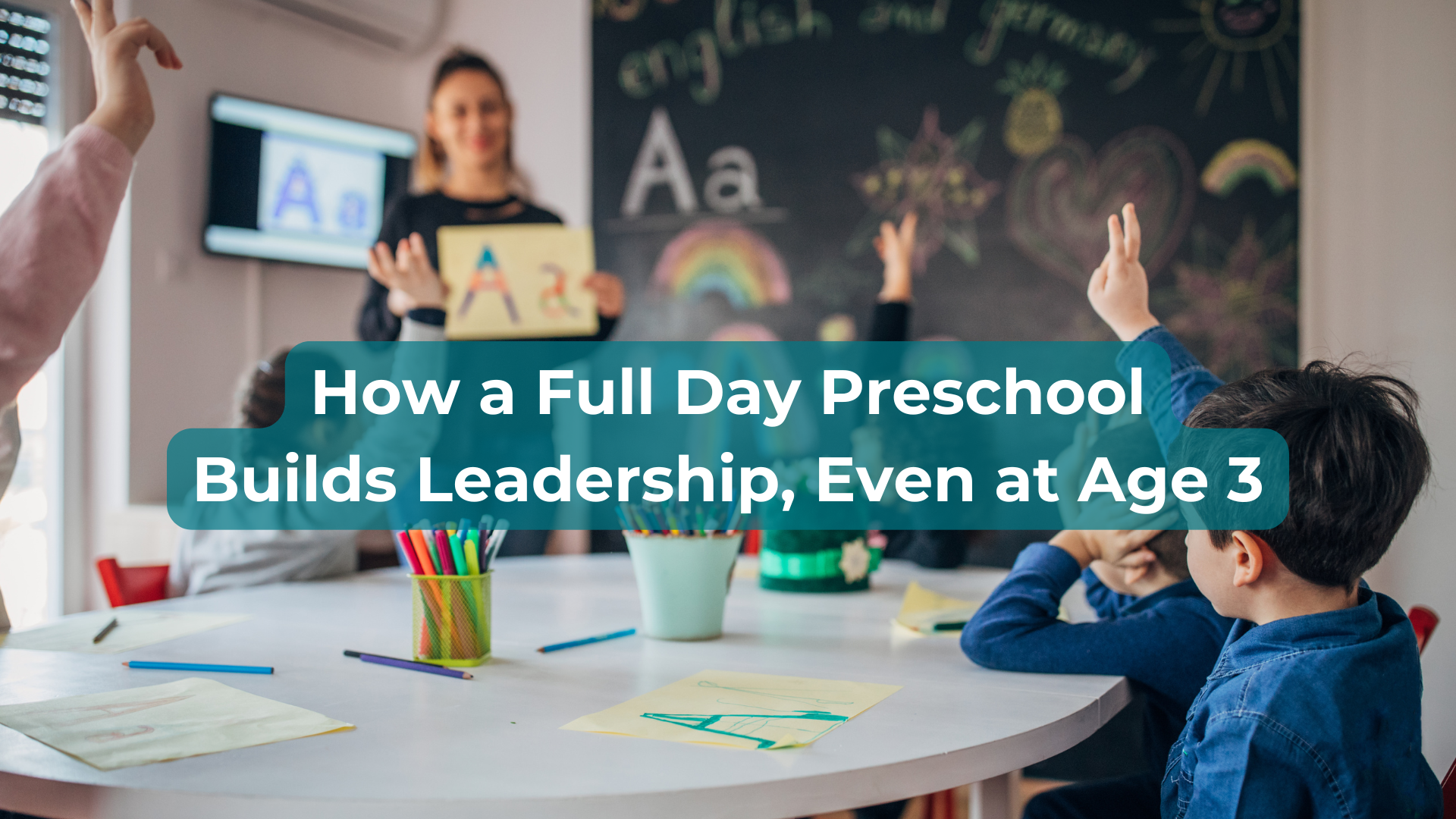
Most people don't think of a three-year-old as a leader. But leadership isn't about age or authority. It's about making decisions, listening to others, and being willing to change your mind when you're wrong. Those skills can start developing much earlier than most parents expect, and the environment matters enormously. A full day preschool gives children the time, relationships, and structure to practice these skills every single day, not just in a three-hour window.
At Acton Academy Calgary Central, we've watched this play out in real time. What happens in our Wonder Studio isn't theoretical. It's three-year-olds standing in front of their peers, making decisions, and leading circles (aka meetings). Here's how it works, and why it matters.
Why a Full Day Preschool Matters for Building Leadership
Half-day programs give children a taste of structured learning. Full-day programs give them something more valuable: time. Time to settle into routines, build real relationships with peers, and practice independence in ways that a three-hour session simply can't support.
Research from the Learning Policy Institute found that full-day programs provide more time for focus, reflection, and transitions between activities, which directly benefits social and emotional development. That's not a small thing. Social and emotional skills are the foundation of leadership.
Our Wonder Studio runs as a full-day, 10 or 12-month program. Every part of the day, from arrival to closing circle, is designed with intention. Children practice time management, make choices about their work, and learn to navigate a community with real expectations. As we describe it on our school schedule page, we give learners "blocks of time for both focused work and imaginative play, within clear and age-appropriate guidelines," which builds self-directed learning from the ground up.
Consistency is what makes this work. Leadership traits like confidence, communication, and accountability don't develop from a single moment. They develop through repetition, across a full day, over months.
The Transformative Power of Character Call-Outs
One of the most important things we do in Wonder Studio is change how we praise children.
Not "good job." Not "that's amazing." Instead, our guides say things like: "I saw so much patience in the way you kept trying," or "that took real perseverance." This practice, which we call Character Call-Outs, is built on a simple idea: when children learn to value who they are becoming, not just what they produce, something shifts.
Our emotional resilience framework puts it clearly: "Praise effort and growth rather than innate ability. 'You worked really hard on that' builds resilience better than 'You're so smart.'" And research from Children's House Montessori supports this, showing that when adults name the virtue they're observing and explain what it means, children begin to internalize those qualities as part of their identity.
In January this year, our guides introduced a daily closing circle where learners share observations about one another, noticing effort, kindness, courage, and focus. At first, the guides modeled it. Then something changed.
After about six weeks, a four-year-old boy raised his hand and asked: "Can I lead the meeting?" He did. The next day, a four-year-old girl volunteered. And on the third day, our youngest learner, just three years old, raised her hand. She wanted to facilitate. And she did.
Developing Decision-Making Skills at Age Three
She stood at the front of the circle. Small. Soft-spoken. Still working on putting on her own jacket. And she led.
When a boy tried to share a second Character Call-Out after already having his turn, she responded without hesitation: "I'm sorry, the meeting is over for today. You'll have to wait until tomorrow." Clear. Confident. Decisive.
But then another learner raised a question: "How do we know when the meeting is over?" The guide didn't step in to answer. The children discussed it themselves. Is it when the circle leader decides? When everyone has had a turn? When the group agrees?
They landed on a shared agreement: the meeting ends when everyone nods and says "thank you." Then a quiet voice pointed out that hadn't happened yet, which meant the boy could technically speak again.
The group turned back to the three-year-old facilitator. She paused. Listened. And said: "You're right. He can go. And then we will close the meeting."
He shared his call-out. The group nodded. They said thank you. The meeting ended.
This is what freedom within limits looks like in practice. Children make real choices, navigate real disagreement, and revise their decisions based on new information. At three years old. Research from Be You confirms that children mostly learn decision-making from those around them, and that the expectations and interactions they experience shape how those skills develop. The environment we build matters.
Socratic Conversations in a Preschool Setting
What made that circle moment possible wasn't luck. It was a culture of questioning that our guides build every day.
At Acton Central, guides don't lecture. They ask. Instead of telling children what to think, they pose questions that invite exploration: "What do you think should happen next?" or "How did working with your partner help you solve that?" This approach, rooted in Socratic dialogue, helps even very young children practice expressing their ideas and listening to peers.
A study published in Early Childhood Education Journal found that the Socratic method can effectively develop critical thinking in preschool-aged children when educators create environments where children can express ideas freely and are guided with open-ended questions. That's exactly what happened in the closing circle. The guide didn't resolve the "when does the meeting end?" question. She let the children work it out.
As we describe in our approach to intrinsic motivation, guides "ask thoughtful questions that challenge learners to think critically and explore different perspectives." Over time, children stop waiting to be told the answer. They start trusting their own thinking.
Preparing for the Future: Why a Full Day Preschool Experience Lasts a Lifetime
It's easy to look at a three-year-old leading a circle and call it cute. But that's not what it is. It's a child practicing leadership, critical thinking, listening, adapting, and owning decisions. Every day she does this, those habits get stronger.
Research from Nobel Prize-winning economist James Heckman found that every dollar invested in quality early learning programs generates up to $14 in long-term return, accounting for outcomes like education, employment, and health. The early years aren't a warm-up. They're the foundation.
At Acton Academy Calgary Central, we frame this through a clear belief: "clear thinking leads to good decisions, good decisions lead to the right habits, the right habits forge character, and character determines destiny." That's not a slogan. It's the design principle behind everything we do, from our mastery-based curriculum to our multi-age studios where older learners mentor younger ones.
Children who go through a full day preschool experience like Wonder Studio don't just learn letters and numbers. They learn how to lead a meeting, revise a decision, and respect a group agreement. Those are skills that compound over time. Who will that three-year-old be in five years? In ten? We think about that every day.
Where Big Futures Take Root
Acton Academy Calgary Central is part of a global network of over 300 Acton Academies. We're Alberta Education accredited, and we've built our program around a simple conviction: who your child becomes matters more than what they memorize.
Our full day preschool, the Wonder Studio, is where that work begins. Ages three and four. Ten or twelve months per year. A community built on curiosity, accountability, and character, available with support from the Affordability Grant at $400 per month.
If you're thinking about what kind of start you want for your child, consider this: a three-year-old with wild curls and a high-pitched voice stood in front of her peers, made a decision, listened to a challenge, changed her mind, and closed the meeting with grace. She practices this every day.
That's what we're building here. And it starts at age three.


