
It is a question we hear on tours of Acton Academy Calgary Central: a child is visibly stuck, the Guide is standing right there, and instead of explaining, the Guide asks another question. Why not just tell them?
The short answer: telling is fast, and fast is not the same as learned. The longer answer is how the Socratic method in education deliberately creates a manageable amount of struggle, and why that struggle is where durable understanding comes from.
What "Productive Struggle" Actually Means
Productive struggle is not a euphemism for letting kids flounder. The Association for Middle Level Education describes it as applying what you already know to a challenging task and learning from mistakes on the way to a solution. The key word is productive: the task sits just beyond what the child can do alone, but within reach with effort and the right prompt.
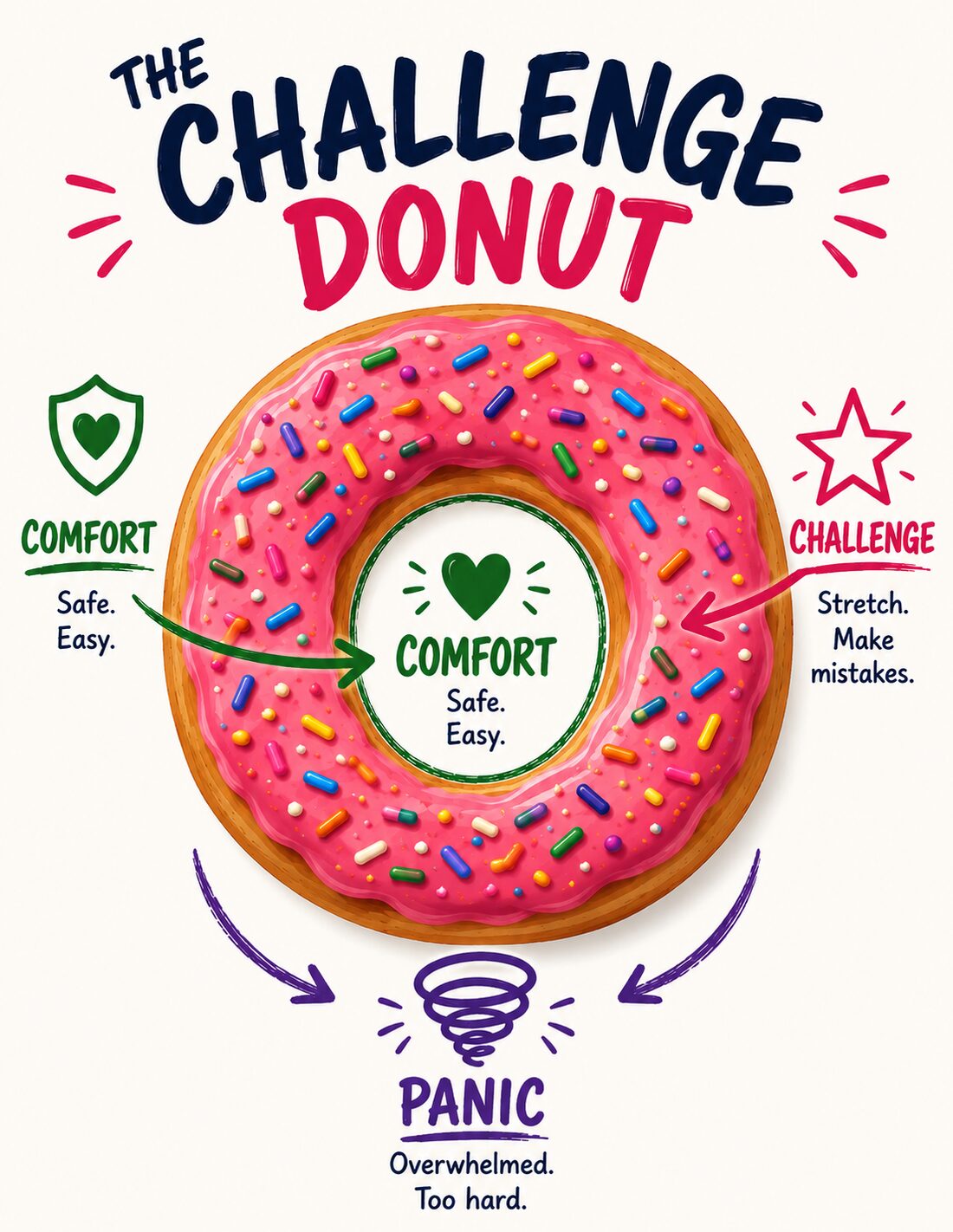
On the walls of Acton classrooms hangs a simple drawing shaped like a donut. We call it the challenge donut, and it helps learners reflect on how challenging their chosen work is.
The centre is the comfort zone. Work there feels safe and easy, like practising a skill mastered long ago. A little time in the middle is fine, but a learner who stays too long gets bored. Outside the donut is the panic zone. There, the work is beyond a learner's current skills and abilities, and that often leads to frustration or overwhelm.
The ring in between is the stretch zone, and it's where we want learners to be. This is where productive struggle happens. The work takes real effort but stays within reach, so learners keep pushing themselves while staying set up for success.
Guides don't tell learners where they are. Through discussion, learners ask themselves where they sit on the donut, how they know, and what it would take to move into the ring. Over time, they get better at noticing when they've drifted, and they learn to set goals that keep them stretching.
The National Council of Teachers of Mathematics lists "support productive struggle in learning mathematics" as one of its eight effective teaching practices in Principles to Actions. The cognitive-science backbone comes from UCLA psychologists Elizabeth and Robert Bjork, who coined the term "desirable difficulties" for conditions that "impede performance during acquisition" but "improve retention and transfer later."
Why the Socratic Method in Education is Built For This
The University of Connecticut's teaching centre describes Socratic questioning as disciplined, purposeful inquiry that pushes learners to examine, validate and articulate their own ideas. The Socratic teaching method works because a well-placed question does four things a direct answer cannot:
- It forces retrieval. "What do you already know about this?" makes the child pull existing knowledge forward instead of waiting for new information.
- It surfaces reasoning. "Why did you choose that approach?" turns a guess into an explanation the child can hear, and often correct, out loud.
- It tests assumptions. "Would that still work if the numbers were bigger?" invites the learner to poke at their own idea before anyone else does.
- It keeps ownership with the learner. When the insight finally lands, it is theirs, not borrowed, and that is the retention-and-transfer payoff Bjork describes.
A 2021 meta-analysis of 53 studies by Sinha and Kapur in Review of Educational Research found that when students attempted challenging problems before receiving instruction, they showed moderately better conceptual understanding and transfer than students taught first and given problems after (Hedges' g = 0.36). Procedural skill was broadly similar either way, which is why struggle sits alongside core skills practice in our day rather than replacing it. Note the sequence, too: the attempt is followed by consolidation. In our studios, that happens in the closing Socratic discussion and in mastery badges, where learners test ideas against peers and the standard before moving on.
The Catch: Struggling Feels Worse Than it Works
Here is the part parents rarely hear about the Socratic method in education: effortful learning feels less effective than it is. In a randomized study of introductory physics students published in PNAS, Deslauriers and colleagues found that students randomly assigned to active-learning classes scored higher on tests of learning than peers taught by experienced, highly rated lecturers, yet rated their own learning lower and said they preferred the lecture format. The authors attribute the gap partly to the extra cognitive effort involved: it feels like confusion, so students read it as failure.
A child who says "the Guide doesn’t help me" may be describing a session of more real thinking than a week of worksheets. This is why the emotional side of struggle matters as much as the intellectual side.
How Socratic Method Teaching Works at Acton Central
We have written before about the challenges and rewards of Socratic teaching; here the focus is the struggle itself. Our Guides make a written promise, published on our careers page: "Never answer a question in the studio, but instead respond with a guiding question." It is a design constraint: if a Guide cannot tell, the Guide has to find the question that moves this child one step forward without removing the challenge. Research on teacher behaviour backs this. A study in the NCSM Journal of Mathematics Education Leadership found that "telling" moves lower the cognitive demand of a task, while reason-provoking prompts keep the struggle productive. Supply the answer, and the task quietly becomes a different, easier task.
Our daily schedule opens with a Launch and Socratic discussion first thing, runs a second Socratic discussion to close the morning work cycle, then again to launch the afternoon Quest, and closes the day with reflections and discussion at 3:30. Elementary learners spend roughly five hours a week in Socratic discussion, debating heroes, history and how to govern their own community. As our post on experiential learning put it: the child does the intellectual work; the Guide holds the space for it.
Struggle in the Socratic method in education is calibrated, not left to chance
Parents deserve an honest caveat. The research on problem-first learning is strongest for older students in math and science; the same Sinha and Kapur meta-analysis found that for learners in Grades 2 to 5 the effect sizes tilted toward instruction first. We serve preschool through Grade 5, so we take that seriously. Three parts of our model keep struggle productive:
- Mastery-based progression. Learners advance only after mastering a skill, so the challenge in front of a child is built on ground they already hold.
- Multi-age studios. In our Spark and Discovery Studios, a stuck learner can be questioned by an older peer before a Guide steps in. Peer explanation stretches both children.
- Quests that make struggle concrete. Our hands-on Quests give abstract problems a physical form, so a failed attempt leaves evidence a child can examine, not just a red mark.
What This Looks Like For Your Child
Imagine an upper elementary learner whose bridge collapses during a Quest. A traditional response is to explain load distribution. Ours is closer to: "Where did it bend first? What was different about that joint?" The learner examines the wreckage, forms a theory, rebuilds and tests again. By the closing discussion, they can explain to peers why the second version held. That explanation, defended under friendly questioning, is the learning outcome; the bridge was the occasion for it.
In plain terms, the Socratic method in education means your child will sometimes come home tired from thinking, and occasionally frustrated that nobody rescued them. Over time, they also come home expecting problems to yield to persistent, well-reasoned effort, which is the core of what we call Learning to Learn.
Questions Parents Ask
Is my child just being left to flounder?
No. Productive struggle means a task the child can reach with effort and a well-timed prompt. A Guide who sees genuine floundering changes the question, not the rule.
Will they fall behind on basics?
Core skills in math, reading and writing run each morning from 9:15 in our daily schedule, and learners advance only after demonstrating mastery, so gaps are caught, not carried forward.
What if they get too frustrated?
Frustration at the edge of ability is expected; frustration past it is not. Our post on emotional resilience covers how to read that line and step in without taking over.
Bringing Socratic Questioning Home
When your child asks for an answer, try one round of questions first: "What have you tried?" "What would happen if…?" "How would you check?" Then pause; the silence is where the thinking happens. If frustration is tipping over, step in, then ask them to explain the solution back to you. Explaining is its own productive struggle.
If you would like to see Socratic discussion in action, we are currently accepting applications for preschool to Grade 5. Visit our application page or schedule a call and bring your questions. We usually answer those with questions, but we make an exception for parents.


